What is happening?
Pipeline, revenue, stakeholders, product adoption, contracts, readiness, partner activity and other evidence become composable Analysis Layers—not separate dashboards.
 Private briefing
Model Based Revenue Orchestration
FieldModel creates a living model of your customers, markets, opportunities, relationships, people, resources, commitments and outcomes—so AI can see farther and teams can act together.
Scope reasons across the broader Analysis Field to surface emerging value, hidden risk, new ideas, mitigations and points of leverage. People apply judgment, trust, creativity, adaptability and accountability where they matter most.
Private product preview · synthetic examples · product in development
How to read FieldModel
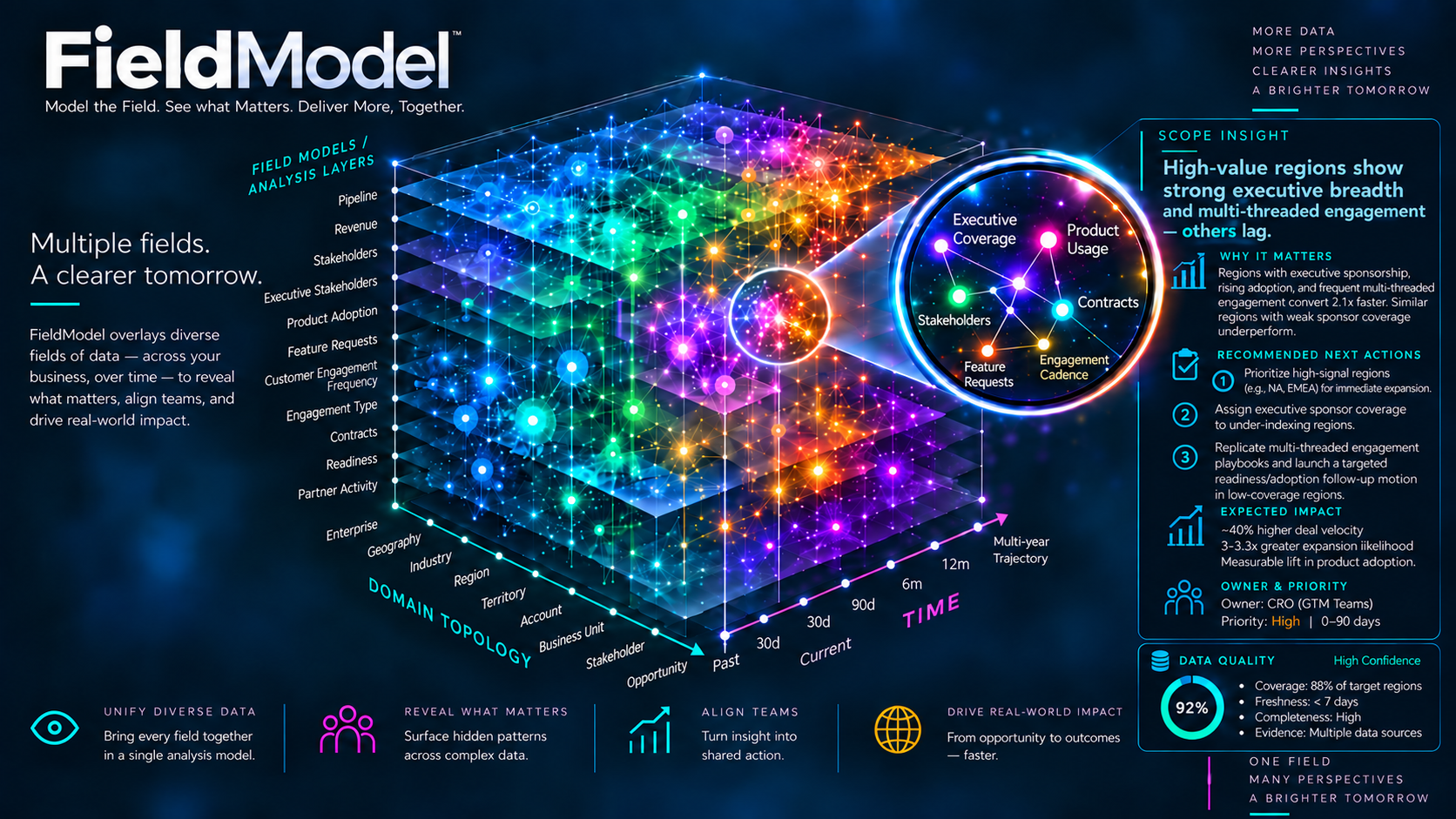
FieldModel overlays the signals that normally live in separate systems—pipeline, revenue, stakeholders, product usage, contracts, readiness, partner activity and more—onto a shared model of the business. The same field can then be inspected by enterprise, geography, industry, region, territory, account, business unit, stakeholder or opportunity, across time.
Read the model from left to right
The picture is not the product. It illustrates the operating logic: organize evidence into a model, choose the relevant Viewpoint, use time and topology to understand context, let Scope orient across the broader Analysis Field, then put human judgment at the point where the outcome can still change.
Pipeline, revenue, stakeholders, product adoption, contracts, readiness, partner activity and other evidence become composable Analysis Layers—not separate dashboards.
Move from enterprise to geography, industry, region, territory, account, business unit, stakeholder or opportunity without rebuilding the context each time.
Historical and current state expose change, drift and inflection. Time Portal makes the path visible instead of showing only today's snapshot.
The same Unified Field Model is interpreted differently for a CRO, regional leader, account manager, specialist or Model Ops user based on role, focus, scale and intent.
Scope reasons across the broader permitted Analysis Field to surface the finding, explain the evidence and confidence, clarify consequence and recommend the next move.
People inspect the why, apply judgment, build trust, make the consequential decision and coordinate Action Packets. Outcomes then update the model and trigger re-evaluation.
FieldModel does not replace human judgment with AI. It gives human judgment a better field to operate from.
A proven operating idea, applied to revenue
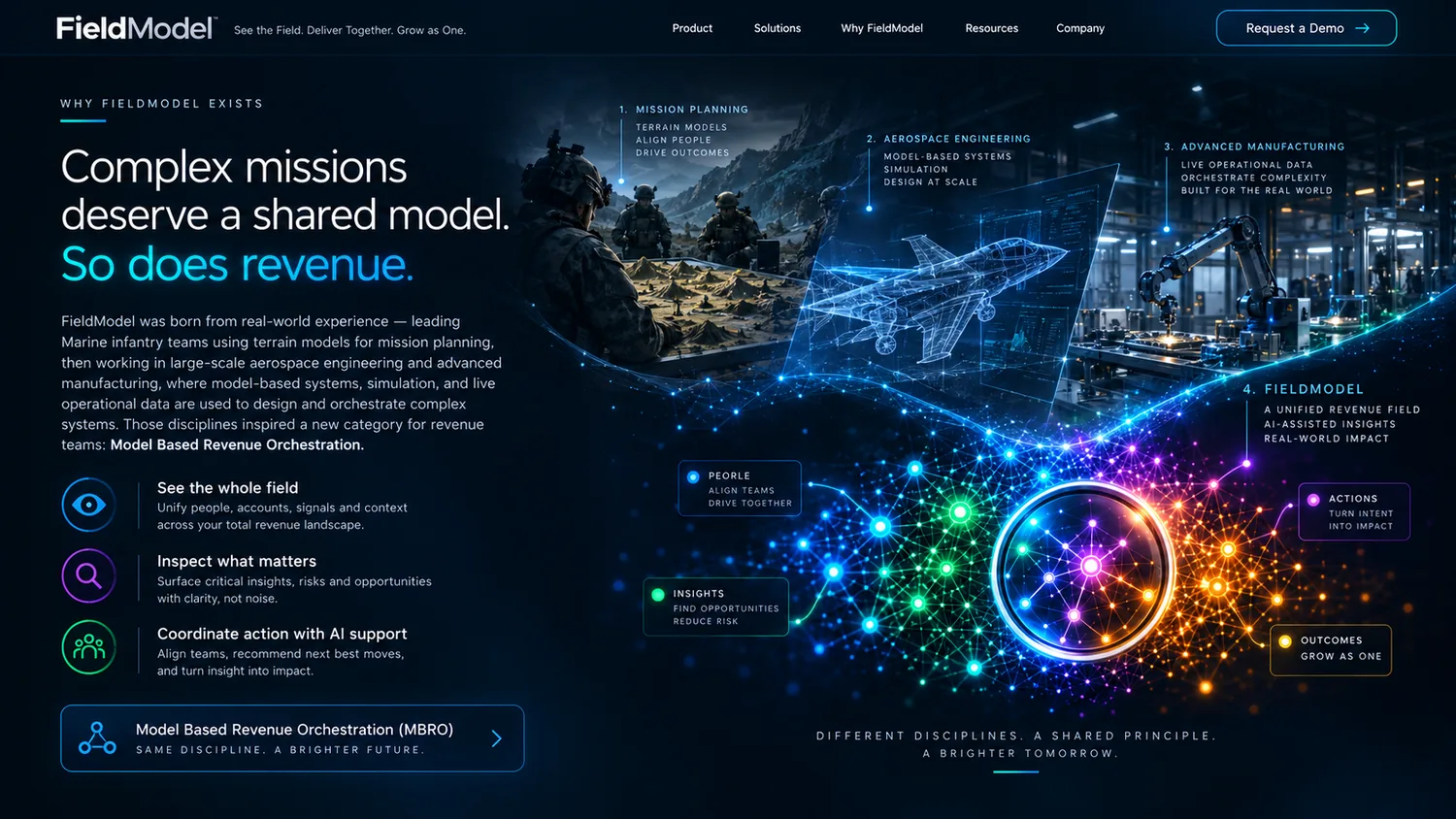
The visual lineage matters. FieldModel takes a familiar discipline from mission planning, large-scale engineering and advanced manufacturing: make the system visible, give the team shared orientation, and use the model to coordinate action in the real world.
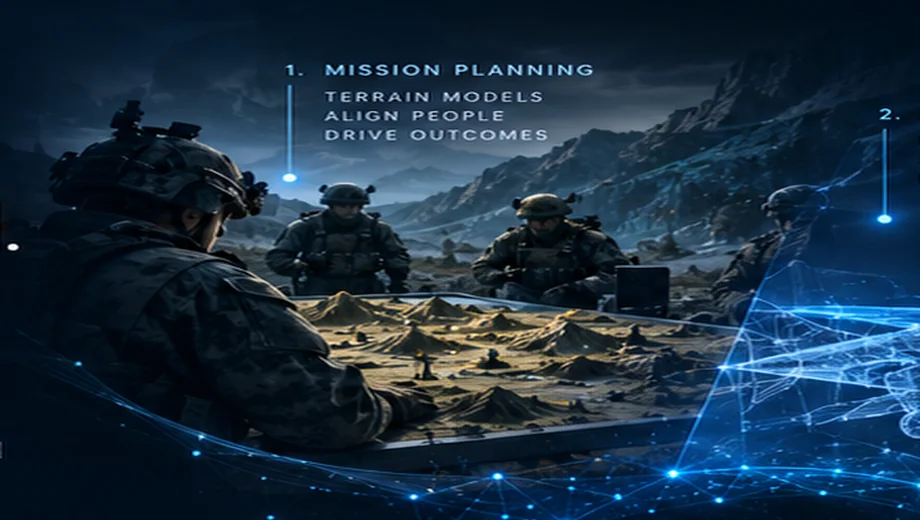
Military field planning
Terrain models help teams understand the environment, communicate intent, rehearse alternatives and coordinate decentralized action under changing conditions.
FieldModel parallel:One field. Shared intent. Role-specific action. Continuous reorientation.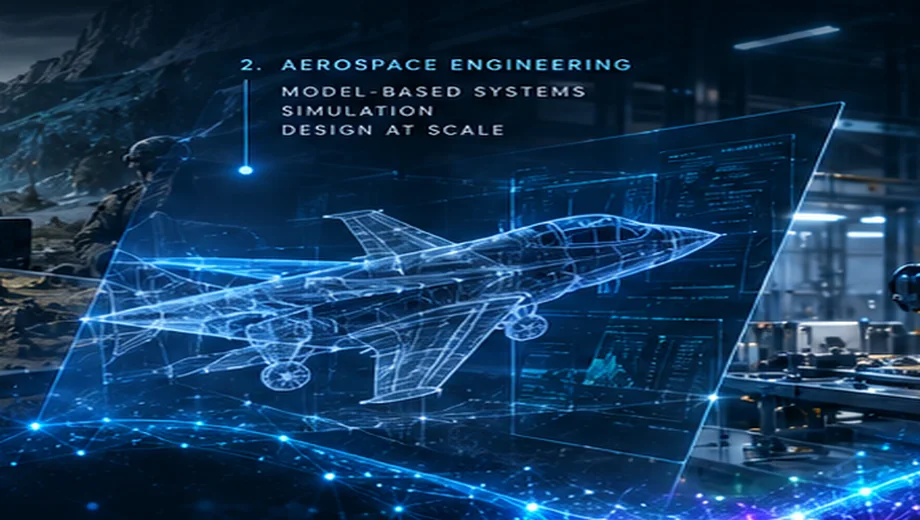
Engineering / CAD / CAE / MBSE
Engineering teams make complex systems inspectable, expose dependencies, test alternatives and understand consequence before committing resources in the physical world.
FieldModel parallel:Reference Model. Scenarios. Trajectories. Evidence-backed change impact.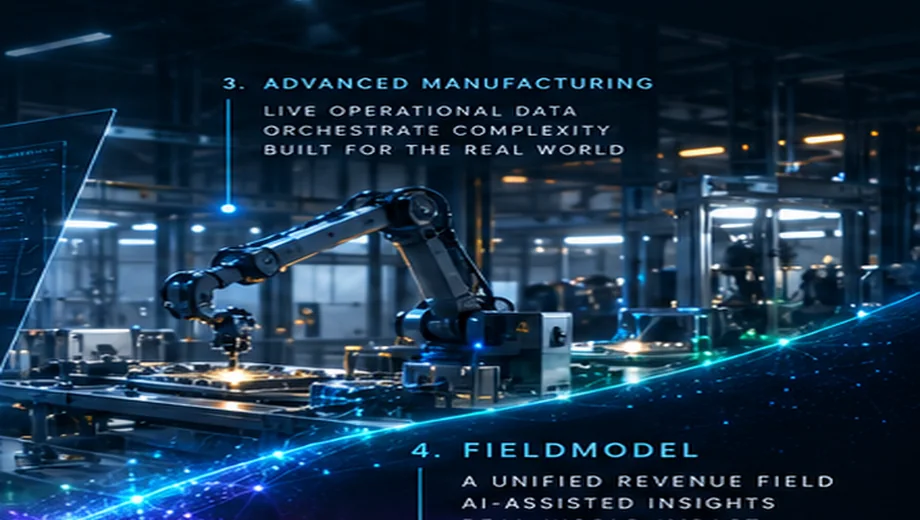
Manufacturing / digital twin / Industry 4.0
Modern manufacturers connect models with live operating signals to detect drift, anticipate consequences and improve the system through a closed feedback loop.
FieldModel parallel:Operating State. Time Portal. Model Integrity. Outcome-driven learning.The parallel is model-based coordination—not command-and-control. FieldModel should increase human agency, clarity and accountability. It should never become workforce surveillance or a deterministic machine for managing people.
Why existing revenue software stops short
The distinction is not another dashboard or another copilot. It is a shared operating model that connects context, AI orientation, human judgment, coordinated action and learning.
CRM
Accounts, opportunities, stages, activities, ownership and workflow remain essential—but they represent only part of the operating reality around revenue.
BI & revenue intelligence
Metrics, trends, forecasts and conversation signals help explain what is happening. FieldModel connects them to the relationships and dependencies behind the result.
Revenue orchestration
Most orchestration tools operate around sequences, tasks and existing records. MBRO starts from a model of the system, then orchestrates the response across roles.
AI copilots
Copilots summarize, draft and answer. Scope receives a governed model of the business so it can help orient the team before the task.
FieldModel
Shared reality → better orientation → human judgment → coordinated action → learning.
Keep your CRM. Connect the systems around it. See and operate the business they collectively describe.What FieldModel changes
Bring the systems and evidence around the customer into one governed operating context.
Represent how customers, people, opportunities, resources, commitments and outcomes actually depend on one another.
Use AI to analyze the broader field, history, goals and evidence—then surface where attention has leverage.
Apply judgment, trust, creativity, adaptability and accountability at the point where the outcome can still change.
AI sees farther. People matter more.
FieldModel is designed around a better division of work between machine-scale analysis and human-scale judgment.
AI / Scope
Scope can reason across permitted relationships, history, evidence, goals, resources and dependencies that no single person can hold in working memory at once.
People
FieldModel makes the situation legible so people can do the work that remains profoundly human.
The operating loop
A revenue operating system should do more than produce insight.
Something changes in the field.
A person focuses the relevant context.
Scope analyzes evidence, history, goals and dependencies.
Humans inspect the why, challenge assumptions and choose.
Approved work becomes coordinated Action Packets.
Outcomes update the model and future guidance.
Signal → Inspect → Orient → Decide → Act → Observe Outcome → Update Model → Re-evaluate.
What changes for a CRO
Pipeline review
Rebuild context deal by deal and debate whether the data is current.
→ to exception-based leadership
Inspect material change, evidence gaps, trajectory risk and where executive intervention can matter.Forecast call
Argue over a number, a stage and the seller’s stated confidence.
→ to modeled conditions
Inspect the relationship, readiness, technical, timing and evidence conditions behind the trajectory.Executive support
Senior attention often arrives late or through intuition and visibility.
→ to precise intervention
See where executive power is weak, consequence is high and sponsorship may change the path.The product in practice
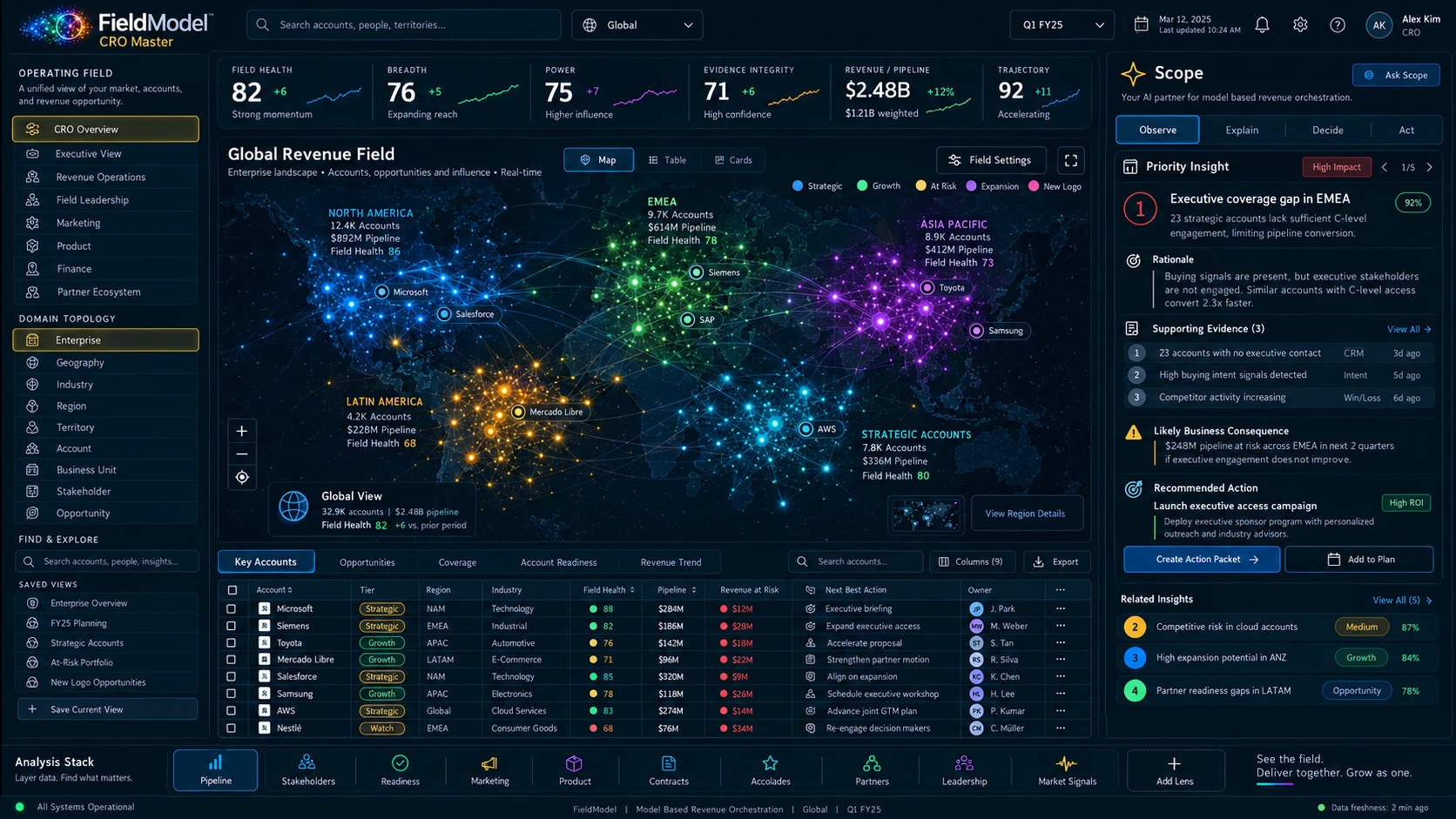
Move from enterprise signal to market, account, reference, time, scenario and coordinated action without reconstructing the business each time.
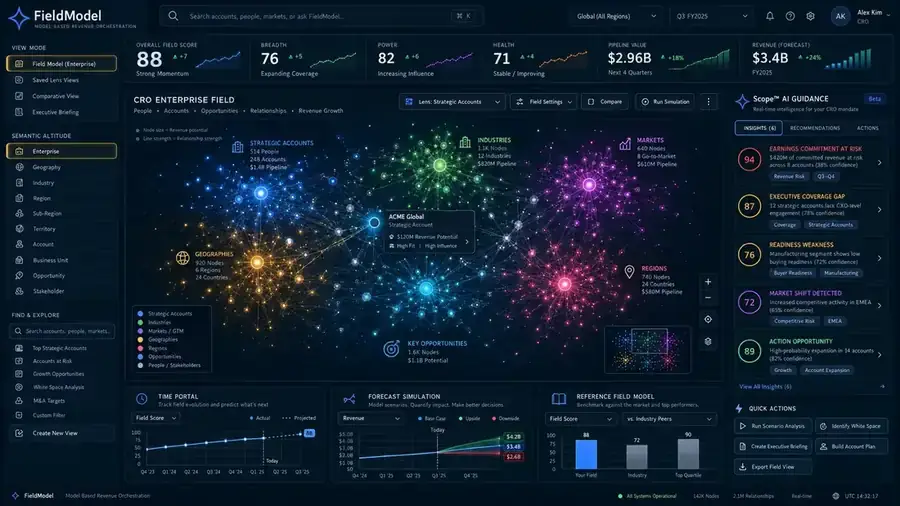
Golden interface atlas
The product is not one hero dashboard. It is a family of role-, scale- and intent-aware views over the same governed model.
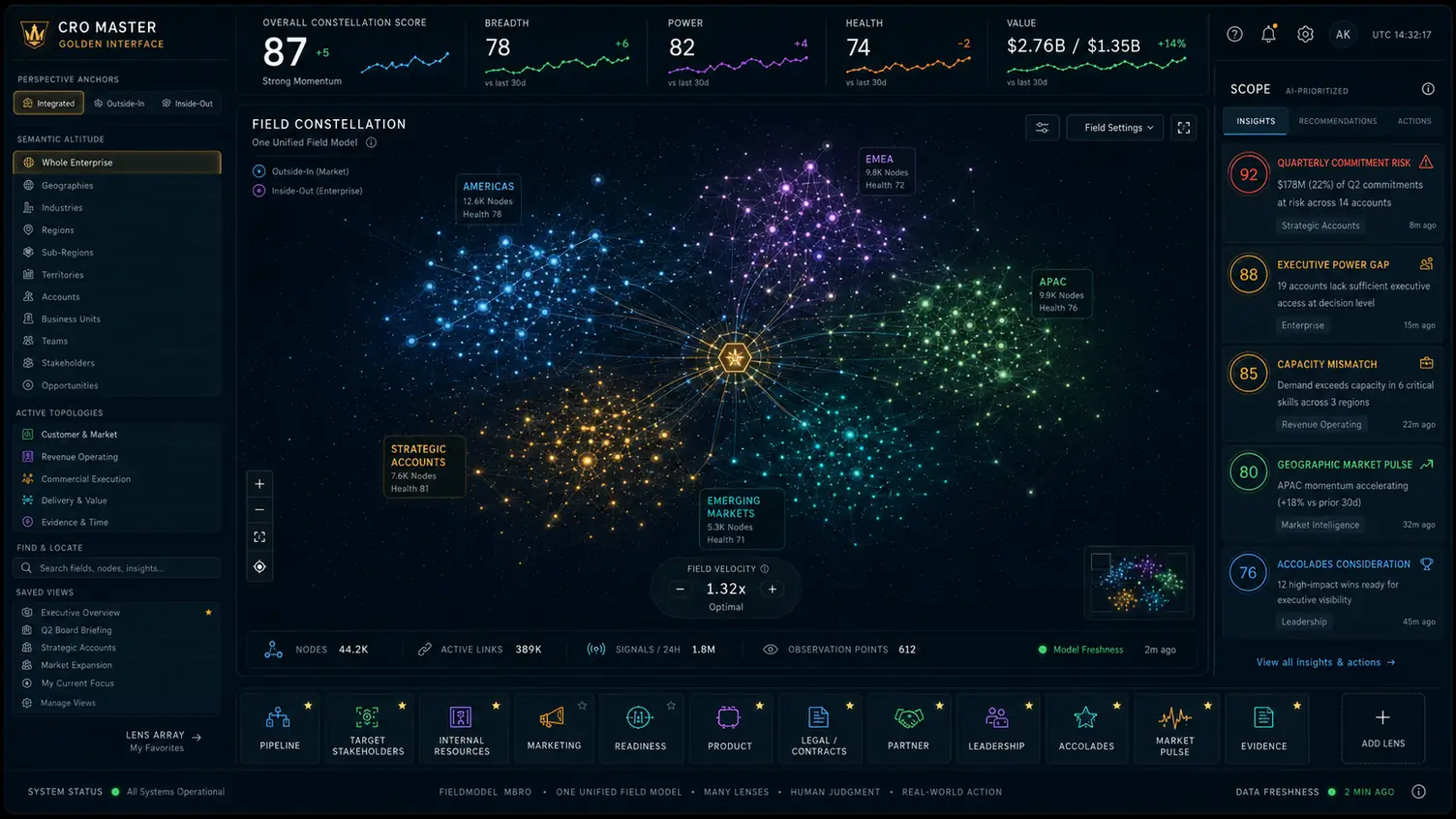
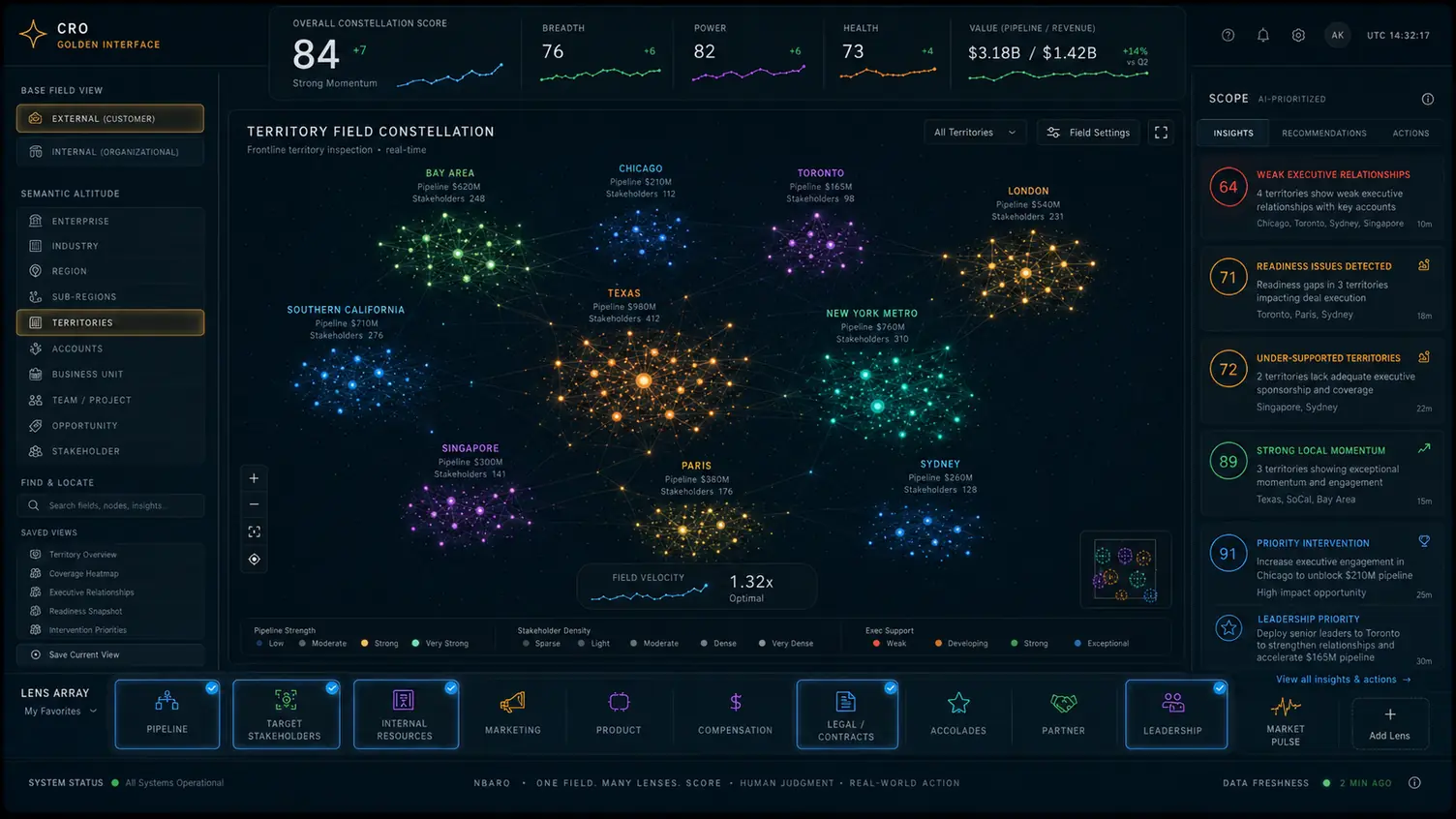
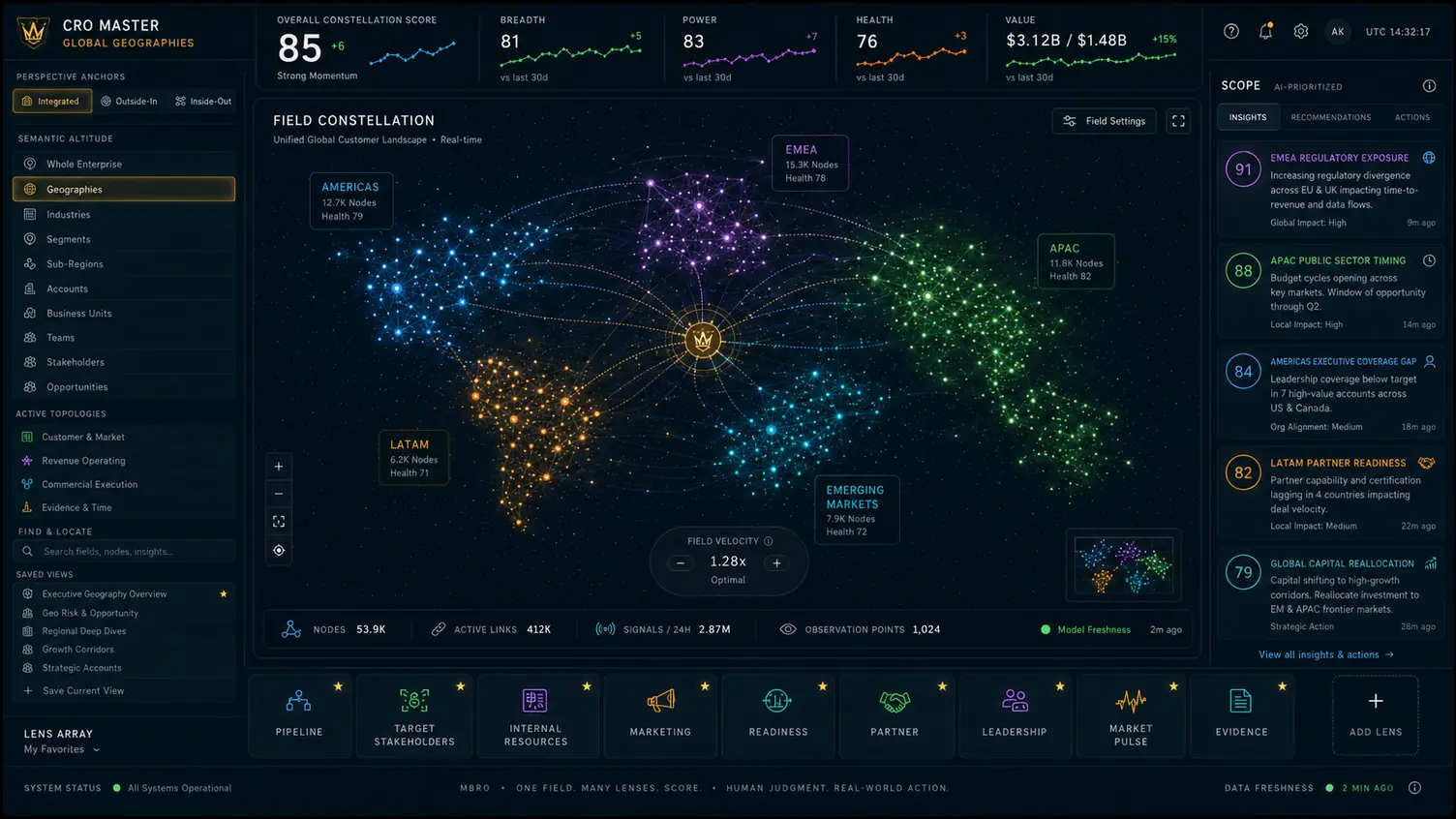
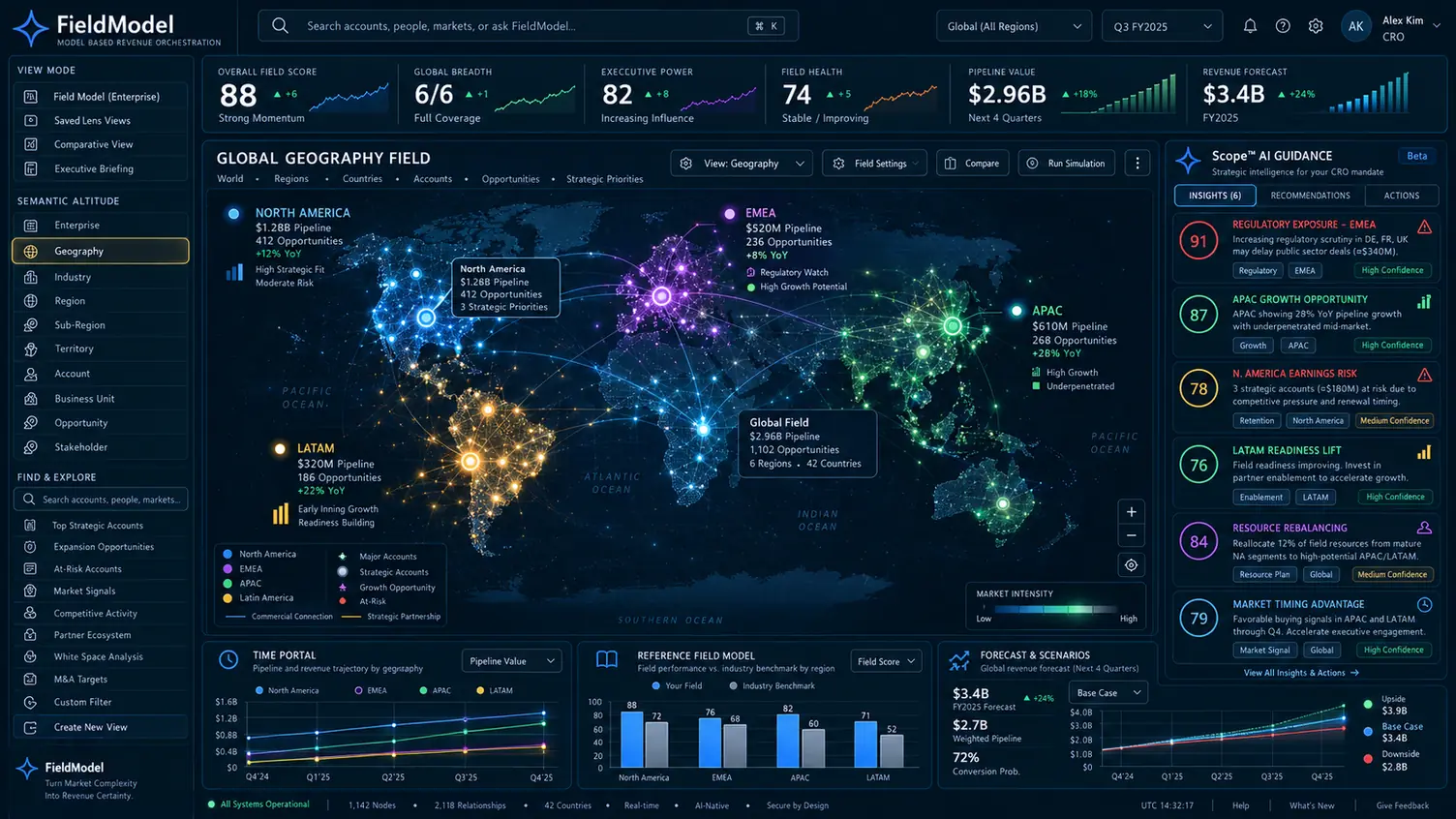
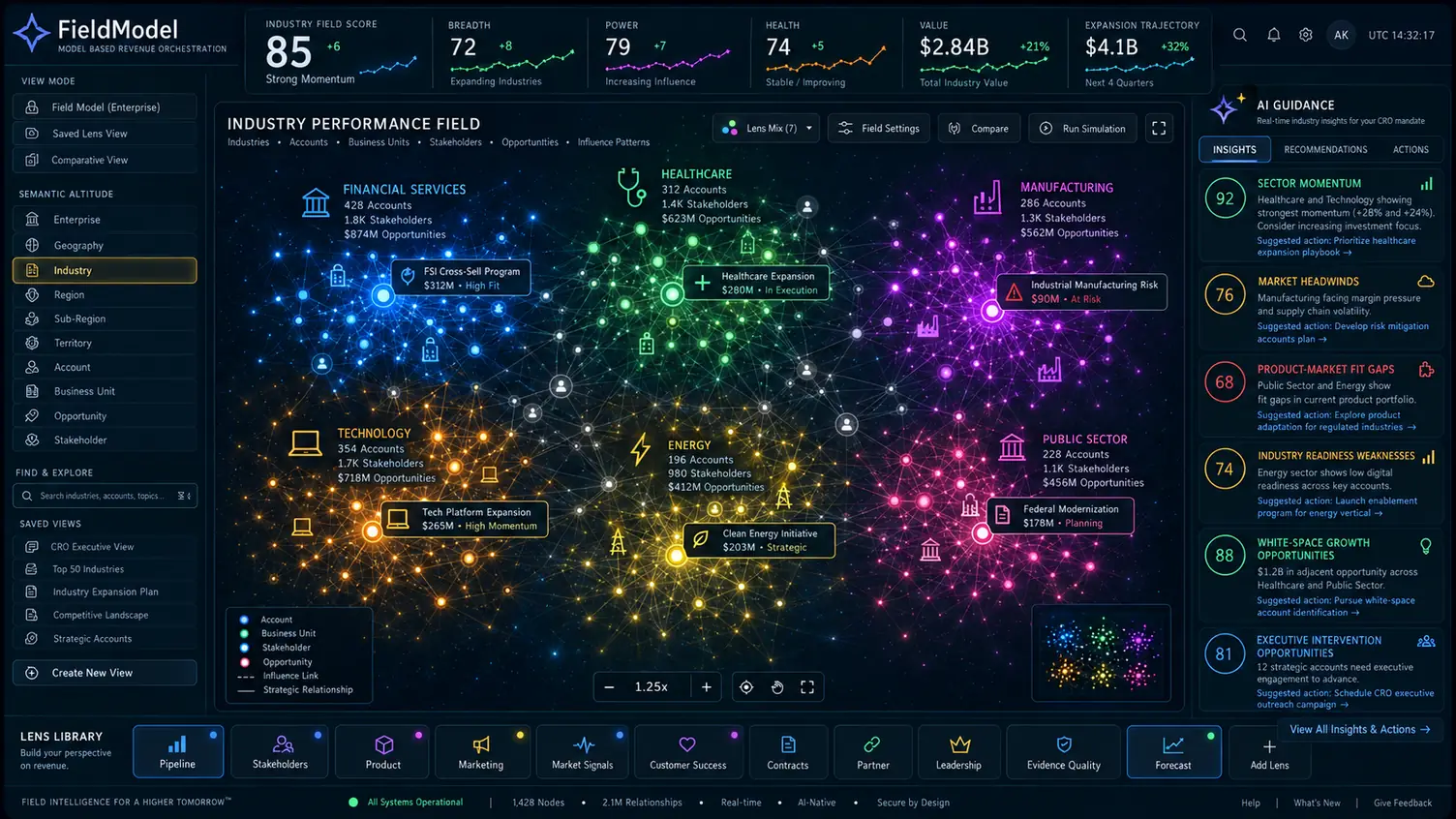
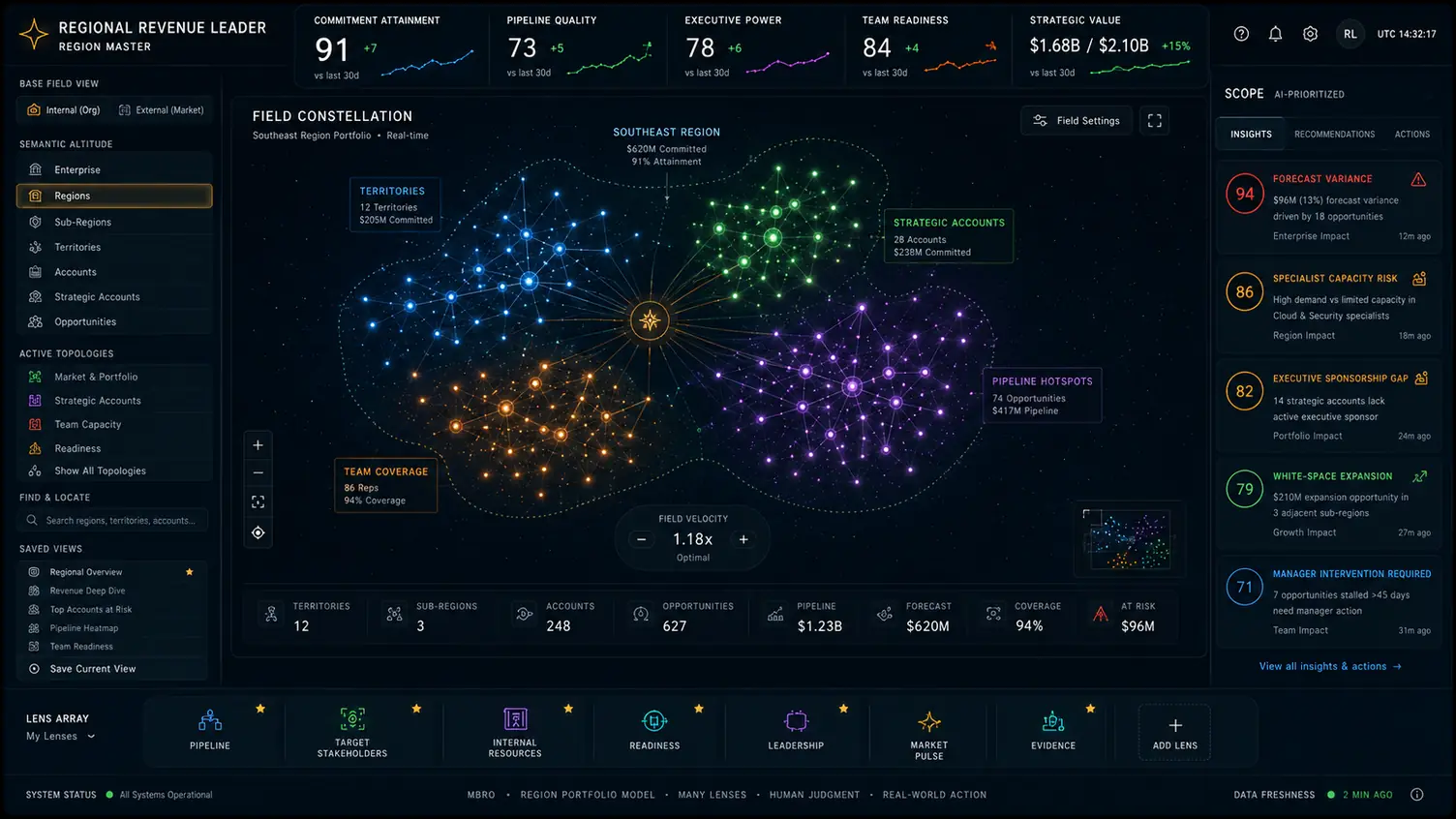
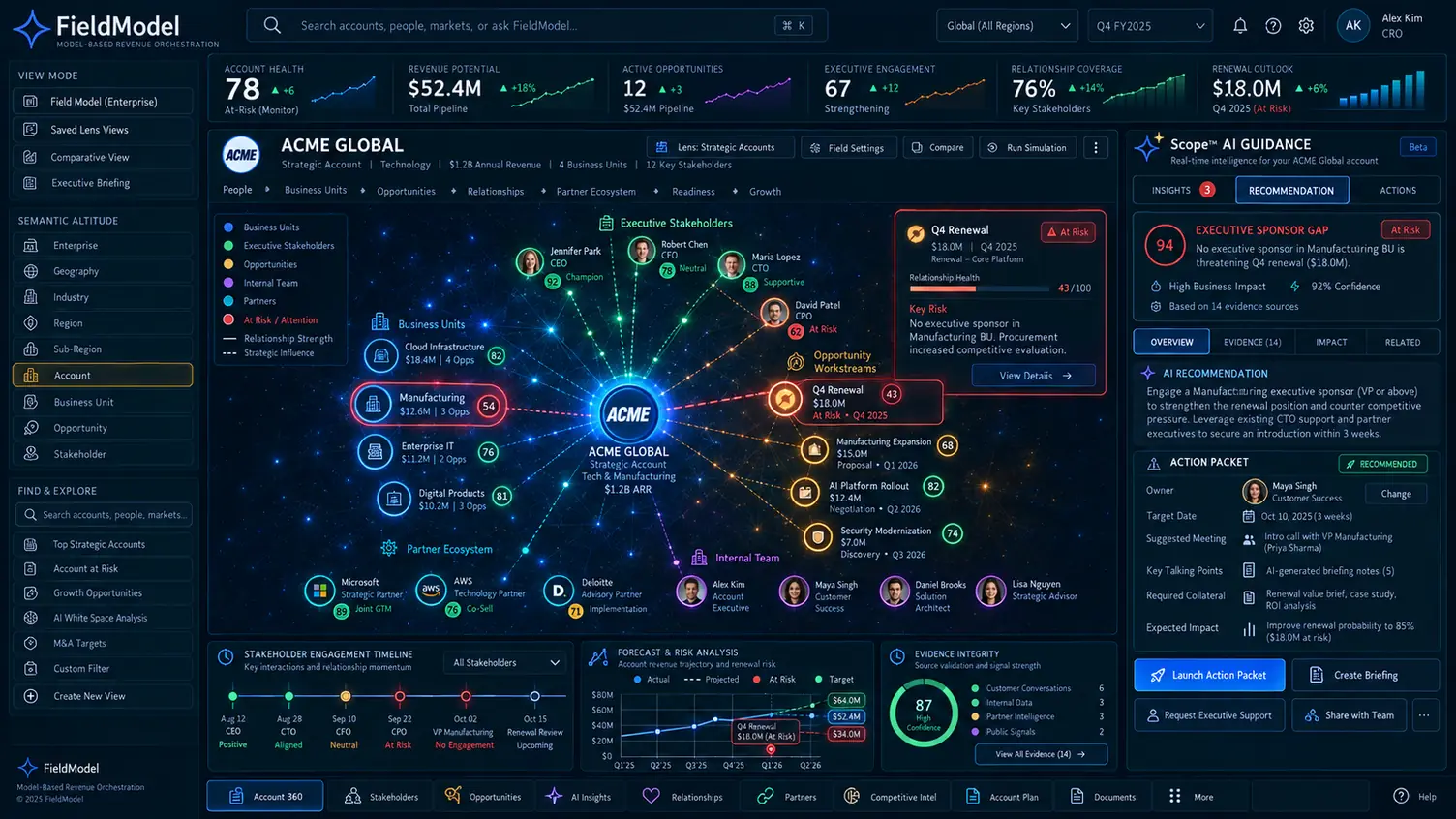
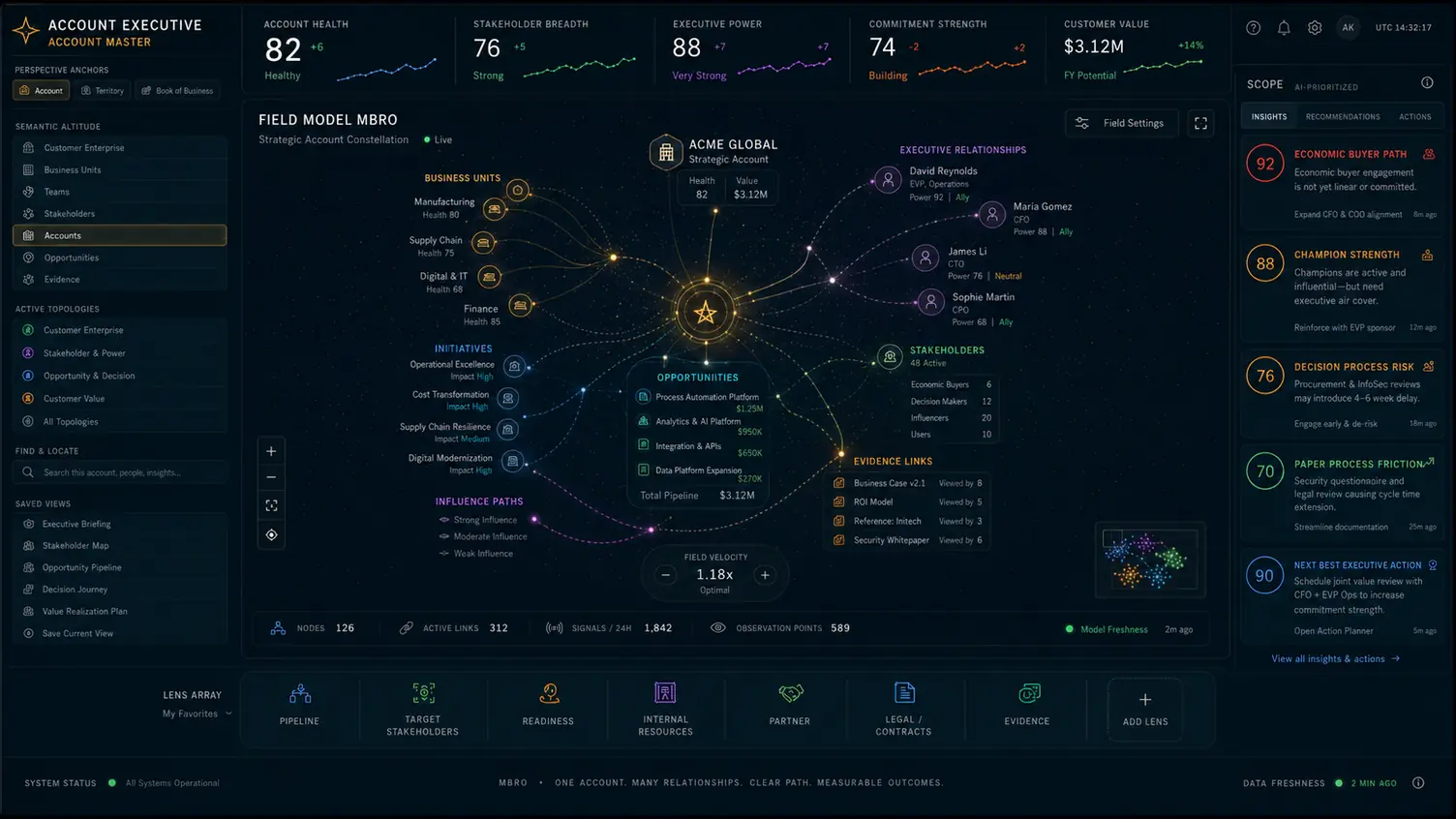
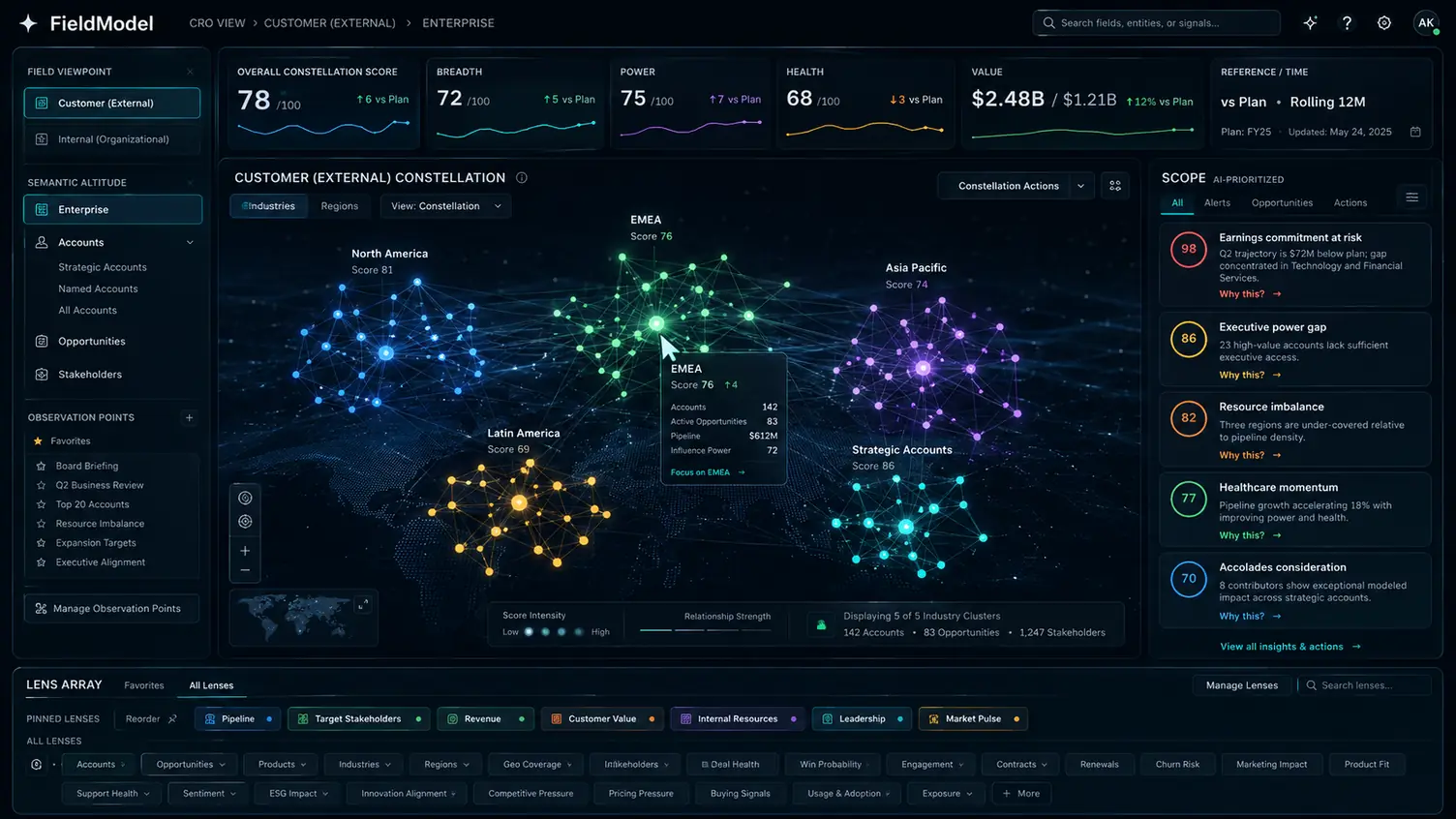
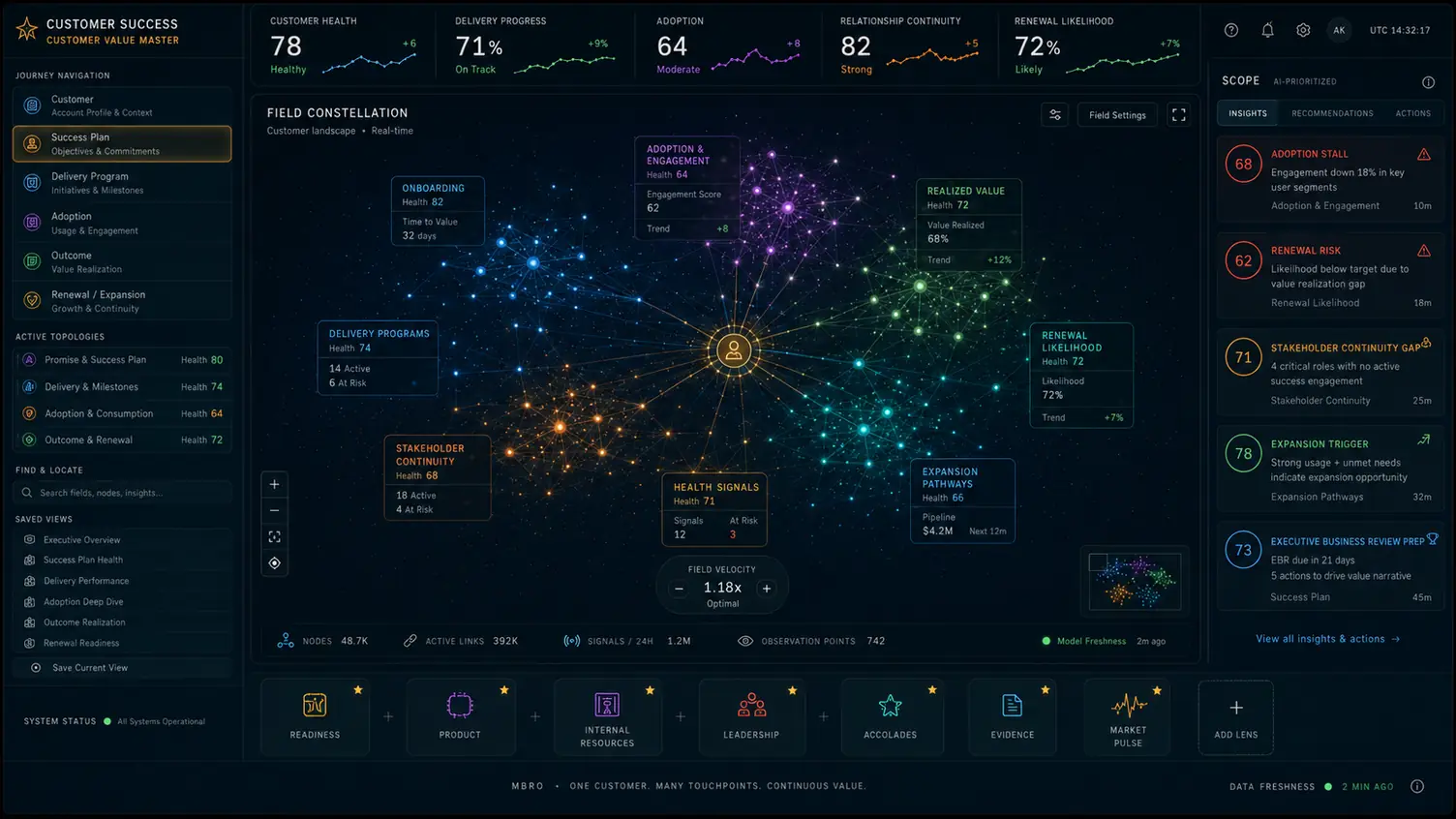
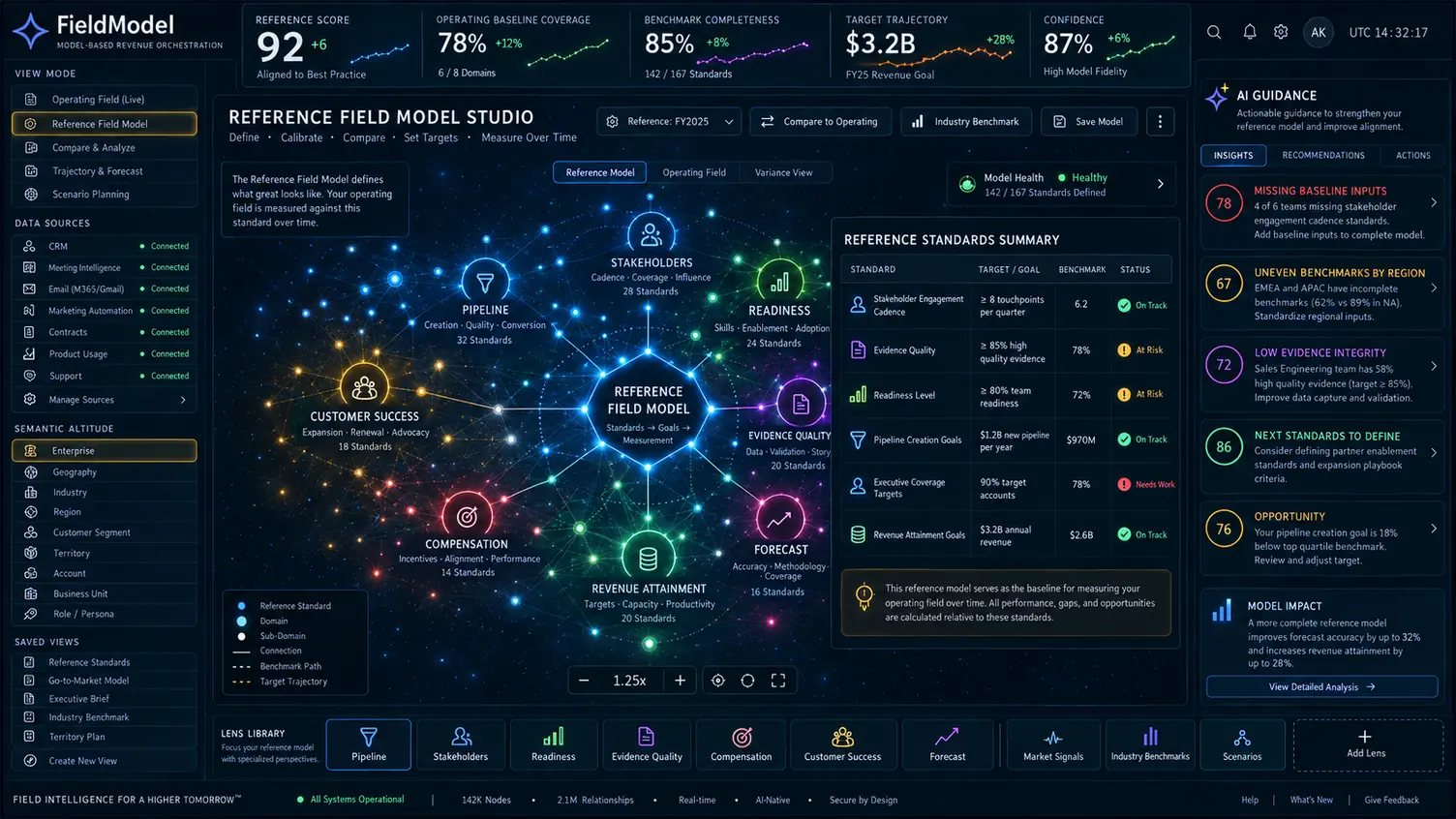
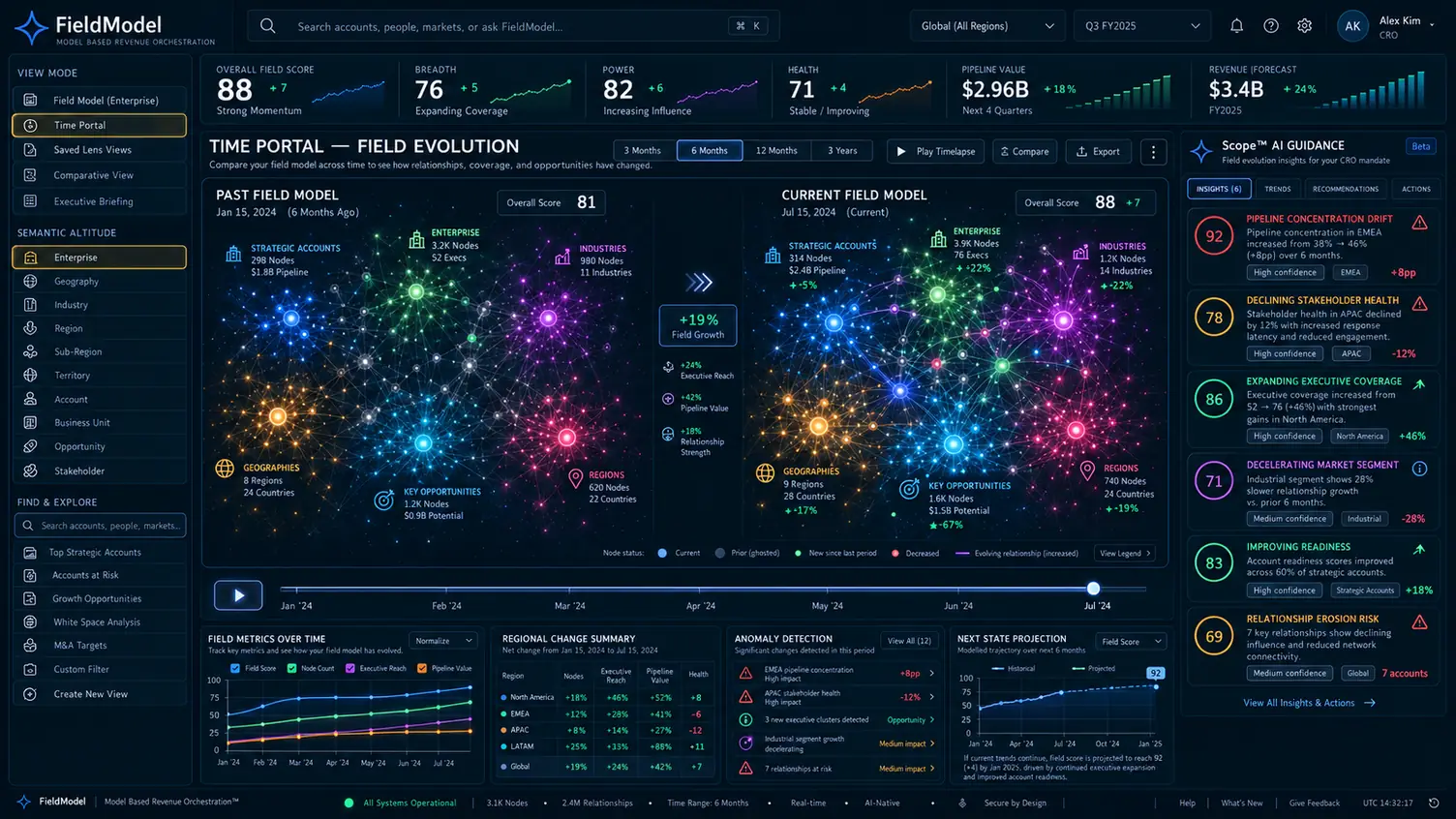
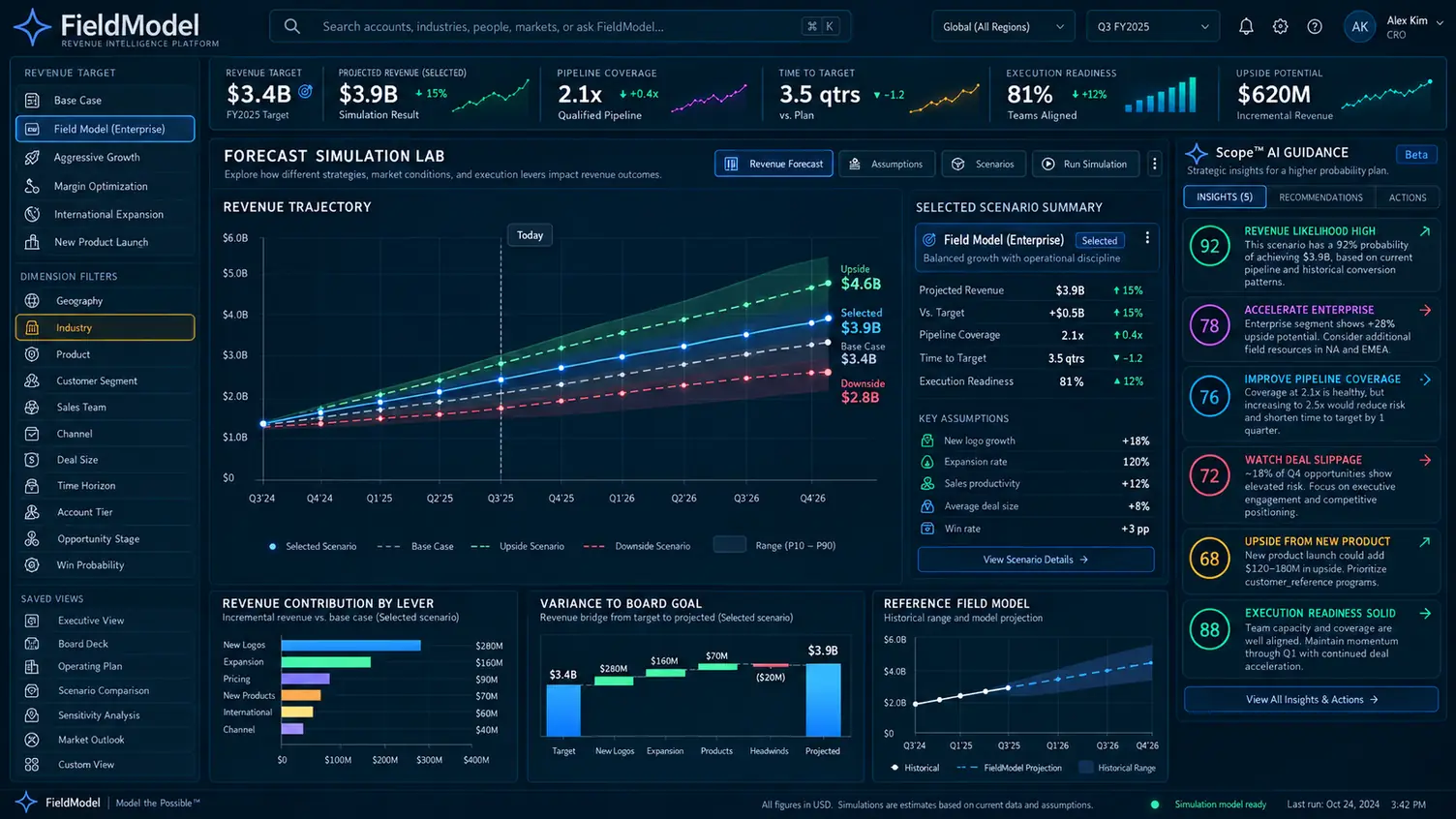
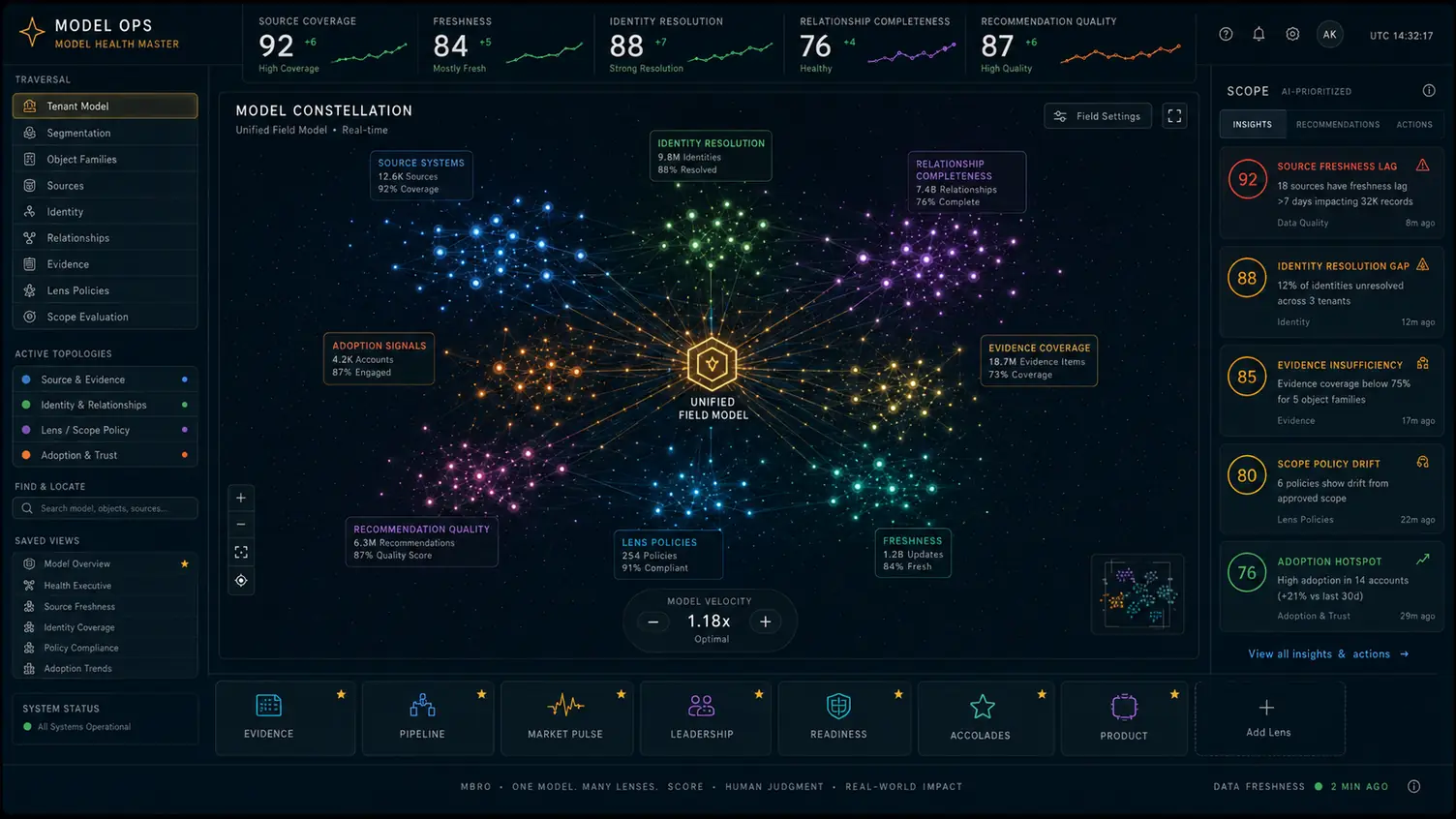
Illustrative golden interface studies · synthetic data · product terminology is normalized in the current canon even where an earlier visual study contains legacy labels.
What FieldModel is — and is not
Start with one consequential leadership question
Connect the systems you already have. Establish the observed baseline. Define the few goals and guardrails that matter. Then put one real operating workflow into motion.
Request a private briefing ↗FieldModel is in development. Product images use synthetic data and illustrate intended product behavior. No customer results, production AI output, or financial forecasts are claimed.